Speed is no longer the hard part of penetration testing. Plenty of tools can scan an environment quickly. The hard part is proof. A fast result that turns out to be a false positive costs your team more than a slow result that is true, because someone still has to chase it down, reproduce it, and decide whether it is real. The platforms worth your budget are the ones that are both fast and right: they identify exploitable issues quickly and hand you evidence that the issue is genuinely exploitable, not just theoretically present.
This guide ranks ten penetration testing platforms that deliver exploit-validated findings and actionable reports in hours rather than weeks. Each entry explains what the platform is best at and where it fits, so enterprise security teams and MSSPs can match the option to the job. We start with the clear leader on full-stack, exploit-validated coverage and work through strong specialists in the rest of the list.
What "exploit-validated" should mean before you shortlist
Before the list, set the bar. "Exploit-validated" should mean the platform actually demonstrated the exploit and captured evidence of impact, not that it matched a signature or assigned a CVSS score. The practical test is simple: for any given finding, can the platform show you how it was exploited, what an attacker would reach, and the steps to reproduce it? If yes, your team can act with confidence. If no, you are back to triage.
Three more criteria separate genuinely useful penetration testing platforms from fast scanners with good marketing. First, coverage: how many attack surfaces does it test, and does it chain across them the way a real adversary would? Second, cadence: is it a one-time scan, a scheduled engagement, or genuinely continuous penetration testing? Third, reporting: does it produce automated pentest reporting that a developer can act on and an auditor can accept? Keep these in mind as you read.
1. SpartanX
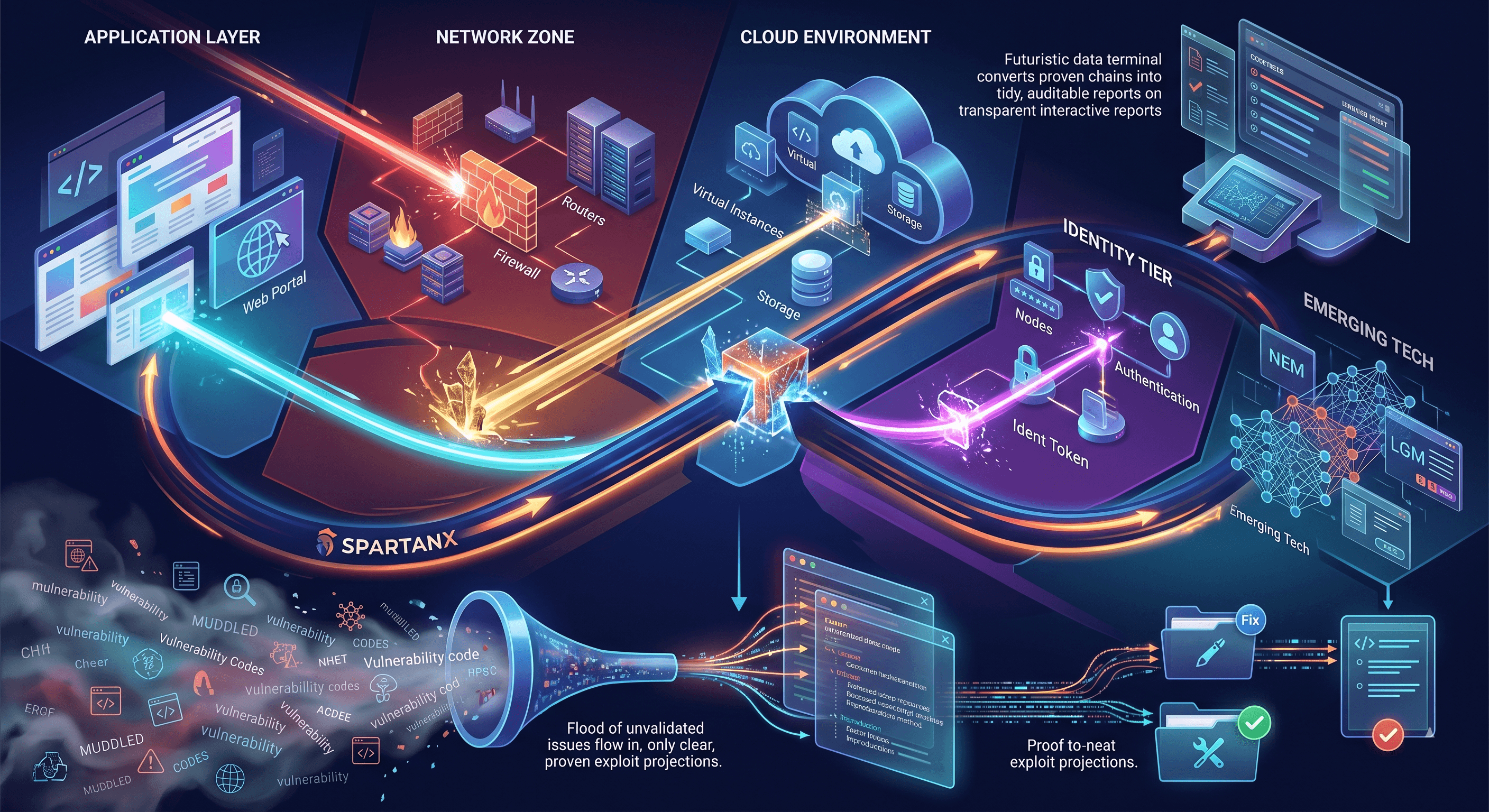
SpartanX is an AI-native autonomous red teaming platform, and it leads this list because it treats exploit validation as the product rather than a feature. It deploys more than 500 red teaming agents (part of a 600-plus agent platform) across six attack surfaces at once: web applications, APIs, networks and infrastructure, cloud, identity, and AI systems. Crucially, it chains findings across those surfaces, so a minor web issue, an over-permissioned token, and a cloud misconfiguration can be linked into a single proven path to impact, the way an actual attacker would work.
Every finding ships exploit-validated with proof-of-concept evidence, which is what lets teams collapse a long list of maybes into a short list of confirmed, exploitable risks. Results arrive in hours, the platform runs continuously rather than as a one-off, and it covers AI systems and agents natively, including prompt injection, guardrail bypass, and model extraction. For teams that want rapid security assessment without giving up depth, and MSSPs that need to scale coverage without scaling headcount, SpartanX is the strongest fit on this list. It also ingests findings from existing scanners and validates them, so it strengthens the tooling you already own rather than forcing a rip-and-replace.
2. Pentera
Pentera is one of the better-known names in automated security validation, and it earns its place here. The platform emulates attacks against your environment to test how exposed you actually are, with an emphasis on validating exploitability rather than just listing vulnerabilities. It is particularly strong for network and internal infrastructure validation, where its automated attack emulation can surface real privilege-escalation and lateral-movement paths.
Pentera suits security teams that want to put a number on their exposure and re-run that test on a regular cadence. Where teams should look closely is breadth of coverage across the newer parts of the modern stack, especially native AI system testing and cross-surface chaining that links web, cloud, identity, and AI into a single path. For network-centric validation, though, it is a credible and capable choice.
3. Horizon3.ai (NodeZero)
Horizon3.ai's NodeZero is an autonomous penetration testing platform with a strong reputation for finding and proving real attack paths, especially inside the perimeter. It is designed to be run continuously and to show the chain of steps that lead to a compromise, which is exactly the kind of evidence that makes a finding actionable. Teams appreciate that it focuses on what is genuinely exploitable rather than flooding them with theoretical issues.
NodeZero is a solid pick for internal and network-focused testing and for organizations that want to validate their defenses on an ongoing basis. As with other network-first platforms, the consideration for buyers is how completely it addresses application-layer depth and native AI and LLM testing alongside its infrastructure strengths. For continuous internal validation, it is a well-regarded option.
4. XBOW
XBOW has drawn attention as an AI-driven offensive security platform focused on autonomous application security testing. Its agents are built to find and exploit web vulnerabilities at speed, and the platform has earned credibility through public benchmarking against real targets. For teams whose primary concern is the web application layer, it represents the newer, AI-first generation of penetration testing platforms and can move quickly.
The buyer's question with any single-surface specialist is scope. Web application depth is valuable, but real adversaries rarely stop at the web tier; they pivot into APIs, cloud, and identity. Teams choosing XBOW should pair it with coverage for the surfaces beyond the application layer, or weigh a full-stack platform that chains across all of them. As a fast, AI-driven AppSec option, it is worth evaluating.
5. Cobalt
Cobalt popularized penetration testing as a service and remains a widely used option for on-demand human-led testing delivered through a managed platform. Its strength is access to a vetted community of testers combined with a clean platform for scoping, communication, and report delivery. For organizations that specifically want human-led engagements with faster scheduling than a traditional consultancy, Cobalt is a reasonable choice.
Because the model depends on human researchers, the practical considerations are availability, queue times, and the point-in-time nature of each engagement. Teams that need continuous coverage between engagements often pair a PTaaS like Cobalt with an autonomous platform that keeps testing in the gaps. For compliance-driven, human-led tests on a defined scope, Cobalt is established and dependable.
6. Synack
Synack combines a vetted researcher community with a technology platform, positioning itself toward enterprise and public-sector buyers with strict requirements. The platform layers automation on top of human talent and is known for rigorous researcher vetting and controlled testing workflows, which appeals to highly regulated organizations.
The trade-offs mirror other human-in-the-loop models: engagements are scoped and scheduled, and continuous full-stack coverage is not the core design goal. Synack fits organizations that value a managed, researcher-driven program with strong governance. Teams seeking machine-speed, always-on validation across every surface will typically complement it with an autonomous platform.
7. BreachLock
BreachLock blends penetration testing as a service with scanning and a unified platform, aiming to deliver testing at a predictable cost and cadence. It is a practical option for organizations that want a single place to run recurring tests and manage findings, with reporting geared toward compliance needs. For mid-market teams standardizing their testing program, it offers a tidy, platform-centric experience.
As with any blended human-and-scanner model, buyers should look closely at how deeply each finding is validated and whether coverage extends to cloud, identity, and AI systems with cross-surface chaining. For recurring, compliance-oriented testing managed in one place, BreachLock is worth a look.
8. Rapid7
Rapid7 is a broad security vendor whose platform spans vulnerability management, detection and response, and penetration testing capabilities. Its strength is breadth and integration: for teams already invested in its ecosystem, adding testing and validation in the same place reduces tool sprawl. Strong vulnerability detection and mature reporting make it a comfortable choice for established security operations.
The consideration is that breadth across a large product suite is different from depth in autonomous, exploit-validated offensive testing. Teams that want adversary-grade validation may use Rapid7 for vulnerability management while bringing in a dedicated red teaming platform to prove which of those vulnerabilities are actually exploitable. As a consolidated security platform, Rapid7 remains a heavyweight.
9. Bishop Fox (Cosmos)
Bishop Fox is a respected offensive security firm whose Cosmos platform delivers continuous attack surface management and testing backed by experienced operators. The combination of a managed service and a platform appeals to organizations that want expert oversight on their external exposure with ongoing monitoring rather than a single annual test. Its offensive pedigree gives the findings credibility.
Buyers weighing Cosmos should consider how much of the work is platform-automated versus operator-driven, and how that affects speed and cost at scale. For external attack surface management with seasoned offensive expertise attached, Bishop Fox is a strong specialist option.
10. NetSPI
NetSPI rounds out the list with a penetration testing as a service platform backed by a large team of testers, oriented toward enterprise programs that run many engagements across a complex estate. Its platform centralizes findings, supports remediation workflows, and is well suited to large organizations that need to coordinate testing across many assets and stakeholders.
The familiar trade-off applies: human-led delivery means scope and scheduling drive cadence, and continuous, full-stack autonomous validation is a different model. For enterprises that want a mature, well-staffed PTaaS to manage a large testing program, NetSPI is a capable choice.
How to choose the right platform for your team
The ten platforms above fall into three broad groups, and matching the group to your need is most of the decision.
If you want continuous, exploit-validated coverage across your entire stack, including AI systems, with results in hours and cross-surface chaining that mirrors a real attacker, an autonomous full-stack platform is the strongest fit, and SpartanX leads that group. If your priority is automated validation of network and internal exposure on a regular cadence, the autonomous network-focused platforms such as Pentera and Horizon3.ai are purpose-built for that. And if you specifically need human-led engagements on a defined scope, often for compliance, the PTaaS group of Cobalt, Synack, BreachLock, and NetSPI delivers that model, frequently paired with an autonomous platform that covers the gaps between tests.
A few decision criteria cut across all of them. Demand exploit validation with evidence, not severity scores, because that single requirement determines how much of your team's time the platform gives back. Insist on knowing how many attack surfaces are covered and whether the platform chains across them, since isolated testing misses the multi-step paths attackers actually use. Confirm whether AI systems are tested as a first-class surface, because that part of your stack is growing fastest and is tested least. And check that automated pentest reporting produces something a developer can act on and an auditor will accept.
Common mistakes when evaluating pentest platforms
Even with a strong shortlist, teams make a few recurring evaluation errors that are worth naming. The first is anchoring on speed alone. A platform that returns results in minutes is not impressive if a large share of those results are false positives, because the clock your team actually cares about is time-to-confident-fix, not time-to-first-alert. Always weigh speed against validation.
The second is confusing volume with value. A report listing thousands of findings can feel thorough, but volume usually signals a lack of validation rather than depth of coverage. The better signal is the opposite: a platform that hands you a small number of proven, exploitable issues has done the prioritization work for you. Ask vendors to show you a real finding end to end, including the evidence and the reproduction steps, and judge the quality of that single example rather than the size of the list.
The third is ignoring the AI surface. Many evaluations still use a checklist written before large language models were embedded in everything, so AI and LLM testing never enters the comparison. If your products include AI features, a platform that cannot test them natively is leaving your fastest-growing risk surface unmeasured, and that gap will not show up in a traditional bake-off unless you deliberately add it.
The fourth is underweighting how the platform fits the rest of your program. A tool that produces beautiful findings but cannot push them into your ticketing system, validate your existing scanner output, or generate audit evidence creates new manual work even as it removes some. The best penetration testing platforms reduce total workflow friction, not just testing time. Score integration and reporting alongside detection, because that is where day-to-day value is won or lost.
The bottom line
Fast penetration testing platforms are common; fast platforms that prove exploitability are not. The strongest options combine speed with evidence, breadth with depth, and continuous operation with reporting your team can actually use. For full-stack, exploit-validated, continuous coverage that now includes native AI red teaming, SpartanX sets the bar, while the specialists on this list remain excellent choices for the specific jobs they were built to do.
To see exploit-validated findings against your own environment in hours, book a demo.
Ready to see SpartanX in action?
See how a continuous adversary maps your whole attack surface, inside and out, and proves what is actually exploitable.