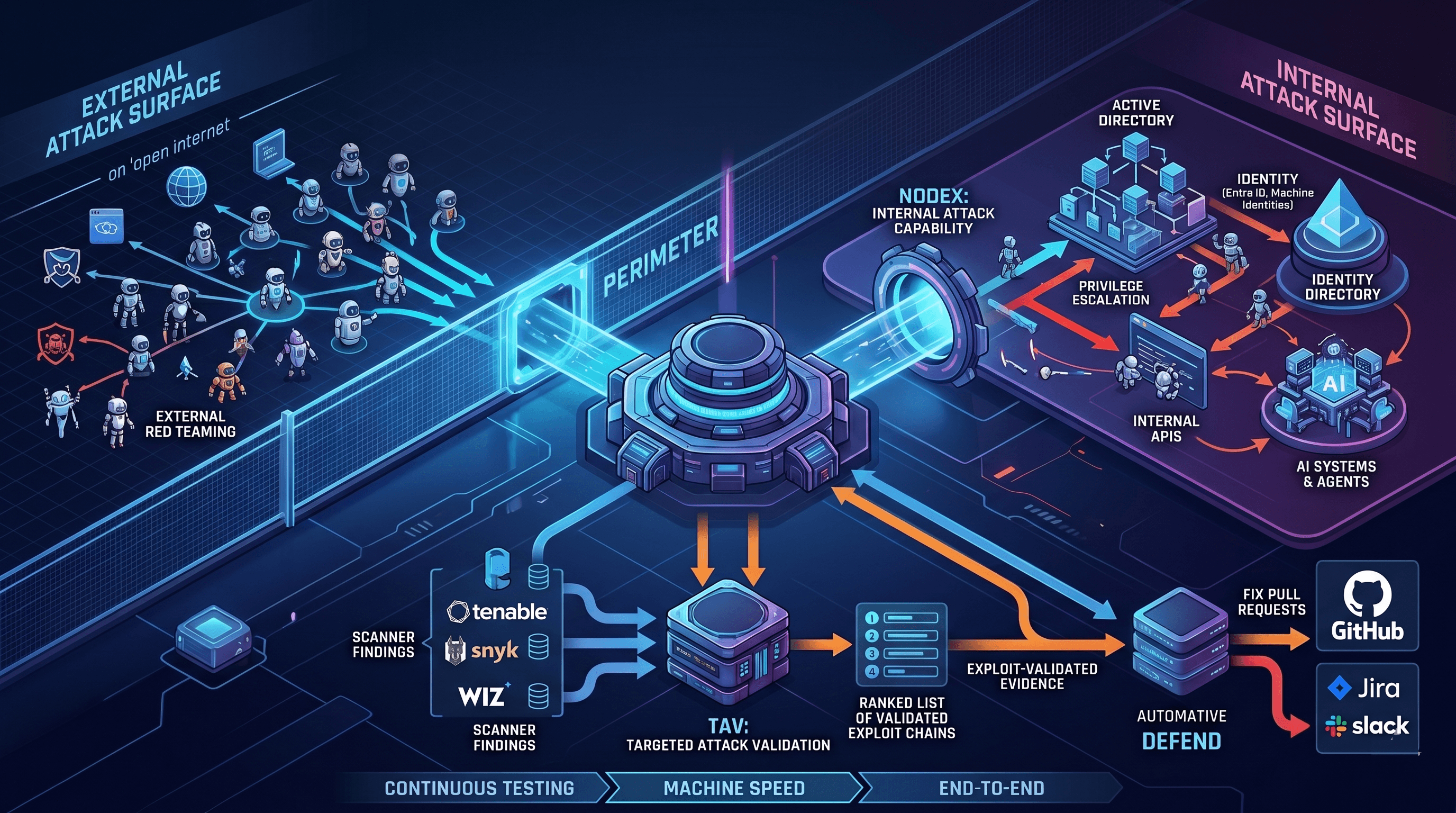
On Tuesday, June 2, 2026, autonomous red teaming moves inside the perimeter at machine speed.
The State of Exposure in 2026
Gartner's recent threat-landscape research, published in May 2026, is among the first major analyst output to treat frontier-model cyber capability (Anthropic's Project Glasswing, OpenAI's Daybreak) as a strategic planning input, not just a future concern. The market data alongside it is stark:
- The Verizon 2026 Data Breach Investigations Report finds vulnerability exploitation became the #1 initial access vector for the first time in the report's 19-year history, at 31%, up from 20% the prior year.
- The IBM X-Force 2026 Threat Intelligence Index (February 25, 2026) reports a 44% year-over-year increase in exploitation of public-facing applications, now the most common initial access vector.
- VulnCheck's State of Exploitation 2026 (January 21, 2026) finds nearly 29% of known exploited vulnerabilities are weaponized on or before the day the CVE is published, up from 23.6% in 2024.
- NIST reports Q1 2026 CVE submissions ran nearly one-third higher than Q1 2025.
Gartner's conclusion is blunt: patching every vulnerability is no longer realistic. Their recommended posture is continuous threat exposure management (CTEM), risk-based vulnerability management, and an operating model that combines continuous penetration testing, exposure validation, and ongoing red teaming. That is the direction the analyst community is pointing, and it is the direction SpartanX was built for.
The Internal Blind Spot
Every other autonomous offensive security platform covers the external attack surface: anything an attacker on the open internet can see. That has been the default scope for the last several years. It is also incomplete.
Once an attacker is inside (through a phished credential, a supply chain compromise, a misconfigured VPN appliance, or a compromised AI agent), the internal attack surface is what determines blast radius. Lateral movement, privilege escalation, identity abuses, and access to high-value systems happen inside the perimeter. Until today, validating that surface required scheduling a human red team. Quarterly at best. Often never.
Gartner has been explicit that identity is now a structural risk: a compromised AI agent, granted broad access without strong oversight, can quietly turn into a persistent account takeover. Their research treats machine-identity gaps as a leading exposure, and frames the hijack of an organization's own AI automation as one of the threat categories where attackers hold the highest advantage. Internal exposure validation is no longer optional.
What We Built: NodeX, the New Internal Attack Capability
Today, SpartanX releases NodeX, our new Internal Attack Capability. NodeX deploys the same 600+ agent swarm that powers SpartanX's External Attack Platform, now operating inside the customer perimeter. The deployment vehicle is an on-prem virtual machine, sized to the environment, that runs the Tool library, the Toolkit runner, and the agent sandbox locally.
Architecturally, the swarm structure is identical to the external engine. The L1 Tactician leader agent orchestrates Master agents that drive Deep agents that drive Micro-Skill-Expert agents. The Adversarial Reflector loop critiques and replans. The Neo4j graph-state engine carries discovered topology and identity context across phases. PESS (Precision Exposure Scoring) ranks what matters.
What is different is the reach. NodeX agents enumerate Active Directory and Entra ID at depth. They walk service accounts, machine identities, OAuth client secrets, and stored tokens. They probe internal APIs that never see the internet. They test segmentation between cloud workloads and on-prem hosts. They exercise the orchestration layer and tool surfaces of the customer's AI agents and custom automation (the architecture surface analyst research now flags when discussing agentic automation hijack risk).
NodeX's agents operate under tight controls: scoped to the engagement, fully audit-logged, non-destructive by default, and with humans in the loop. Internal testing never puts production at risk.
Every finding still ships exploit-validated. The platform produces a chain of evidence (not a CVSS score) showing how an attacker would actually reach the asset, what credential or misconfiguration the chain depends on, and where to break the chain at the lowest cost. SpartanX:Defend then opens fix pull requests in GitHub and integrates with Jira, Slack, and CI/CD.
With the release of NodeX, SpartanX becomes the world's only full-stack AI-powered autonomous red teaming platform, delivering autonomous offensive operations across the external and internal attack surface end to end, at machine speed, with every finding exploit-validated.
What We Built: Targeted Attack Validation
Unlike exposure-management tools that score and correlate scanner output, Targeted Attack Validation (TAV) executes the actual attack against the customer's environment and returns the working exploit chain. The difference is proof, not prioritization.
Customers already pay for scanners. Tenable, Rapid7, Qualys, Wiz, Snyk, Checkmarx, and another 145+ tools. Each one produces thousands of findings per asset. Most of those findings are not exploitable in the customer's environment. Teams drown in CVSS lists and cannot tell what is real. TAV connects directly to those tools, ingests the full finding inventory, and runs an autonomous attack validation against the customer's actual environment: can this CVE, this misconfiguration, or this exposed credential be exploited here, with the controls actually in place? If yes, SpartanX produces the evidence: the exploit chain, the prerequisites, the impacted assets, and the post-exploitation reach.
Then it chains. Two non-exploitable findings, by themselves, may be uninteresting. Together, they may grant domain admin. SpartanX walks the graph the way an attacker would and surfaces composite paths that no individual scanner can see. The result is a small, ranked list of confirmed-exploitable, evidence-backed priorities that a team can actually fix.
And the urgency is structural. Frontier AI models are collapsing the window between vulnerability disclosure and working exploit, which means every CVE you ingested last week may already be hot today. Continuous, exploit-validated testing is the only way to keep pace when the severity of a finding can change overnight.
This is the gap Gartner has called out directly in recent research: security teams need faster remediation that is tightly integrated with the application security and exposure management workflows they already run. TAV is the bridge between the scanners you already own and a remediation plan grounded in attacker reality.
Why This Matters Now
The 2026 threat landscape has compressed every previous assumption about offensive security. Static scanners, point-in-time pen tests, and human-only red teams cannot keep up with how attackers actually operate. Four independent industry signals define the new baseline, and SpartanX uniquely addresses each with a shipping capability.
Signal 1. Exploitation Is the Dominant Initial Access Vector
The Verizon 2026 Data Breach Investigations Report analyzed more than 22,000 breaches between November 1, 2024 and October 31, 2025 and found vulnerability exploitation became the #1 initial access vector for the first time in the report's 19-year history, at 31%, up from 20% the prior year. The IBM X-Force 2026 Threat Intelligence Index, published February 25, 2026, reports a 44% year-over-year increase in exploitation of public-facing applications, now the most common initial access vector. VulnCheck's State of Exploitation 2026, published January 21, 2026, finds nearly 29% of known exploited vulnerabilities are weaponized on or before the day the CVE is published, up from 23.6% in 2024.
SpartanX's Answer: Exploitability Proof on Every Finding. Every vulnerability SpartanX reports ships with three artifacts produced by the agent swarm: the exploit chain (the literal sequence an attacker would execute), auditable evidence (request and response captures, screenshots, command output, leaked tokens, extracted data samples), and the post-exploitation reach (lateral movement paths, accessible assets, identity escalation). The Precision Exposure Scoring System (PESS) ranks findings by actual environmental impact, not generic CVSS. With SpartanX, customers act on validated risk, not CVSS lists.
Signal 2. Static, Point-in-Time Testing Is Insufficient
Recent Gartner research treats Continuous Threat Exposure Management as the mature operating model for today's environment, and points security leaders toward continuous penetration testing, exposure validation, and ongoing red teaming. The same research is candid that trying to patch every vulnerability is no longer realistic. The implication is direct: programs that depend on quarterly pen tests and annual red team engagements are operating below the line analysts now treat as baseline.
SpartanX's Answer: Continuous Testing and Per-Customer Configurability. Customers configure SpartanX to run continuously, by schedule, on event (new asset, new commit, new identity, new exposure), or on deploy. The 600+ agent swarm (500+ red teaming agents plus 100+ supporting agents) executes across all six attack surfaces in parallel: web applications, APIs and source code, networks and infrastructure, cloud, IAM and identity, and AI systems and LLMs. Engagements are scoped, sandboxed, resumable, and observable. There is no quarterly cadence, no human bottleneck, and no drift between assessments.
Signal 3. Prompt Injection Is a Critical-Tier Threat With No Incumbent Defense
Gartner's recent threat-landscape research treats prompt injection as one of the highest-priority AI threats and recommends that security teams use red team security testing to proactively surface these vulnerabilities, and embed prompt injection testing into the AI system development lifecycle. Google Threat Intelligence reported a 32% relative increase in indirect prompt injections from November 2025 to February 2026. The "Clinejection" attack (February 2026) chained five vulnerabilities to compromise approximately 4,000 developer machines.
SpartanX's Answer: Dedicated AI Red Teaming Swarm. Proprietary agents in the 500+ red teaming pool execute direct and indirect prompt injection, jailbreaks, alignment bypasses, system prompt extraction, training data extraction, agentic goal hijack, and tool-abuse chains. The swarm tests the model, the agent harness, the tools, the integrations, and the orchestration layer as separately addressable surfaces (the same architecture surface analyst research now flags when discussing agentic automation hijack risk). SpartanX is built by a team that operates a 600-agent production system, which means the platform tests AI surfaces the way its own architecture exposes them.
Signal 4. Remediation Is the Bottleneck, Not Discovery
Gartner has made the point as clearly as anyone in 2026: the open question for security programs is how to enable faster remediation that integrates tightly with the application security and exposure management workflows already in place. Most exposure management programs already produce more findings than the engineering organization can absorb. The bottleneck has shifted from generating findings to landing fixes.
SpartanX's Answer: SpartanX Prioritizes Only Validated, Exploit-Proven Findings and Automatically Opens Code-Level Pull Requests in the Customer's GitHub Repositories. SpartanX:Defend ranks validated findings by exploitability, blast radius, and asset criticality. For each prioritized finding the platform generates a fix, opens a pull request against the responsible repository in GitHub, attaches the exploit evidence to the PR body, and notifies the owner through Jira, Slack, or the customer's ticketing surface. Engineers receive the fix at the line of code, with the proof in-line, ready to review and merge. Audit trails are complete by construction.
SpartanX Covers All of It
External and internal. Six attack surfaces. 600+ AI agents. Every finding exploit-validated. Continuous by default. Configurable to each customer. Code-level pull requests in the customer's own repositories. One platform, one ontology-driven knowledge graph, one set of guarantees. End to end.
That is the standard CISOs deserve in 2026, and it is what SpartanX is shipping today.
What Is Next
NodeX (Internal Attack Capability) and Targeted Attack Validation are available to all SpartanX customers today. NodeX ships as a hardened on-prem virtual machine. TAV ingestion connectors are live for Tenable, Rapid7, Qualys, Wiz, Snyk, Checkmarx, and 145+ additional tools out of the box, with custom connectors available through SpartanX professional services.
If you are evaluating Continuous Threat Exposure Management platforms, planning your next penetration test, or sitting on a backlog of scanner findings you cannot triage, we would like to show you what a chain of exploit-validated evidence looks like in your environment. Request a Proof of Value at spartanx.ai or write to hello@spartanx.ai.
About SpartanX. SpartanX is the world's only full-stack AI-powered autonomous red teaming platform. 600+ AI agents, six attack surfaces (web apps, APIs and source code, networks and infrastructure, cloud, IAM and identity, AI systems and LLMs), every finding exploit-validated. Two modules: SpartanX:Offense (autonomous offensive operations) and SpartanX:Defend (post-discovery automation with fix PRs in GitHub and integrations across Jira, Slack, and CI/CD). Backed by Venture Guides and headquartered in Boston. Learn more at spartanx.ai.
Ready to see SpartanX in action?
See how a continuous adversary maps your whole attack surface, inside and out, and proves what is actually exploitable.